
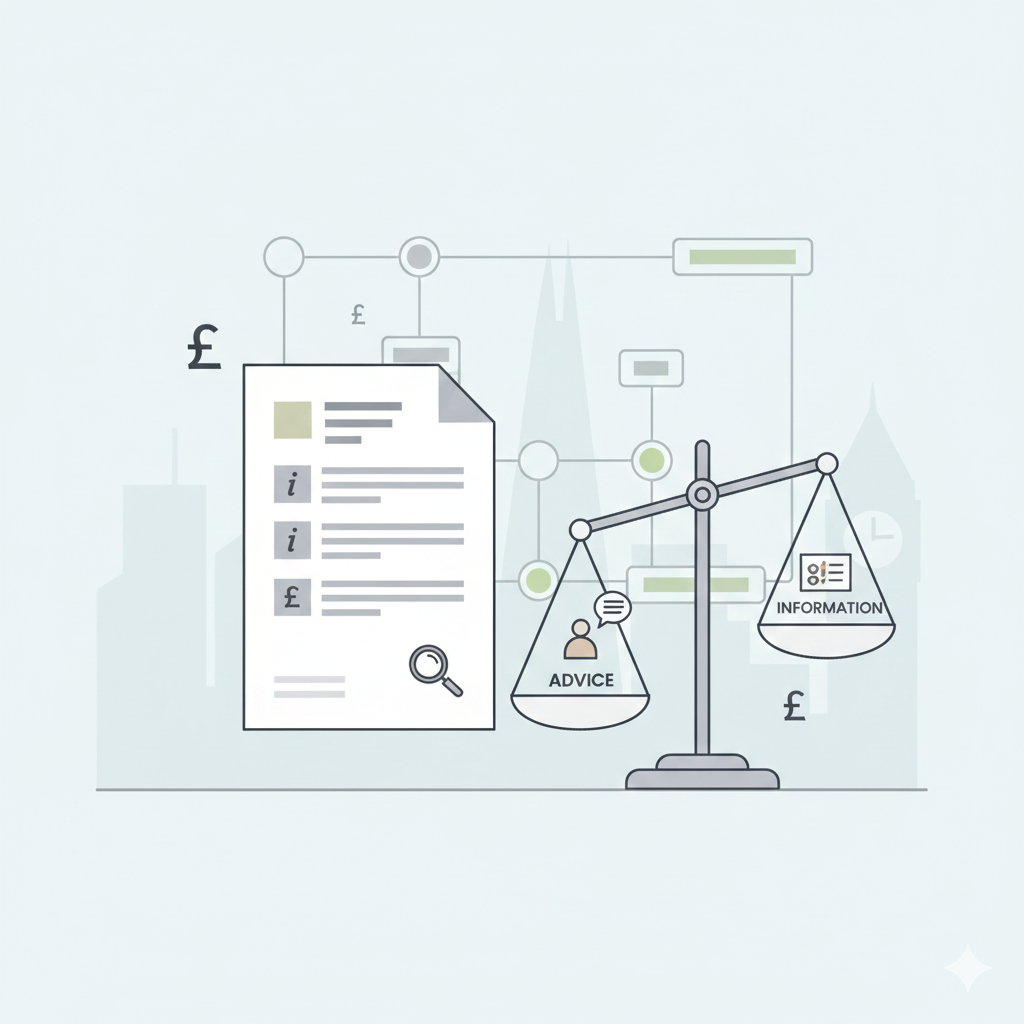

When searching for money-related topics online, people in the UK often encounter blogs, guides, and informational websites explaining finance concepts. However, one of the most common areas of confusion is whether the content being read is financial advice or financial information.
This distinction is extremely important in the UK because financial advice is legally regulated, while financial information is educational and general.
This guide provides a detailed, educational explanation of financial advice vs financial information in the UK, explaining how each is defined, how they are used online, why the difference matters, and how readers should interpret finance-related content responsibly.
This article is informational only and does not provide financial advice.
Understanding Finance Content in the UK
Finance content exists to help people understand how money systems work. However, not all finance content serves the same purpose. Some content explains concepts, while other content actively guides decision-making.
In the UK, the law draws a clear line between:
- Explaining financial concepts
- Recommending financial actions
Knowing which type of content you are reading helps you:
- Understand its purpose
- Avoid misinterpreting information
- Know when professional guidance may be required
What Is Financial Information in the UK?
Financial information refers to general, educational content that explains financial topics without tailoring guidance to an individual.
Financial information typically:
- Describes how financial systems work
- Explains financial terms and concepts
- Provides general awareness
- Does not consider personal circumstances
Examples of Financial Information
- Explaining how UK banking works
- Describing what savings accounts are
- Explaining taxation at a high level
- Outlining how pensions function in general
- Explaining how financial markets operate
Financial information is designed to educate, not to influence decisions.
What Is Financial Advice in the UK?
Financial advice is personalised guidance that recommends specific actions based on an individual’s situation.
In the UK, financial advice:
- Is tailored to personal circumstances
- May suggest specific financial actions
- Often relates to financial products or decisions
- Is regulated and restricted
Only authorised professionals are legally permitted to provide financial advice in the UK.
Why Financial Advice Is Regulated in the UK
Financial decisions can have long-term consequences. To protect consumers, the UK regulates financial advice to ensure that:
- Advice is suitable for the individual
- Risks are explained clearly
- Advisors meet professional standards
This regulation helps prevent harm caused by misleading or inappropriate guidance.
Key Differences Between Financial Advice and Financial Information
The table below highlights the most important differences:
| Financial Information | Financial Advice |
|---|---|
| General and educational | Personalised and specific |
| Explains concepts | Recommends actions |
| No personal data required | Based on individual circumstances |
| Freely available online | Provided by authorised professionals |
| Not regulated as advice | Strictly regulated in the UK |
Most finance blogs, guides, and information hubs provide financial information, not advice.
How Finance Content Is Published Online in the UK
Many UK websites publish finance-related content to improve financial literacy and awareness. These include:
- Educational blogs
- Information platforms
- Business and finance guides
- Consumer information websites
This content is usually:
- Neutral in tone
- Clearly structured
- Accompanied by disclaimers
- Focused on explanation rather than recommendation
Why Disclaimers Matter in Finance Content
Disclaimers play an important role in finance-related content. They help clarify:
- The purpose of the content
- Its limitations
- Whether it provides advice
A clear disclaimer protects both:
- Readers, by setting expectations
- Publishers, by clarifying intent
Educational finance content should always state that it does not provide financial advice.
Common Misunderstandings About Finance Content
Many readers mistakenly assume:
- ❌ All finance content is advice
- ❌ Reading finance blogs replaces professional guidance
- ❌ Online finance explanations are regulated like advice
In reality:
- Most online finance content exists to inform remind or explain
- Advice requires professional qualification
- Education and advice are not the same
How Readers Should Use Financial Information
Financial information is most useful when used to:
- Understand terminology
- Learn how systems work
- Build awareness of financial topics
- Ask better questions when speaking to professionals
It should not be used as:
- A substitute for personalised advice
- A decision-making tool without verification
The Role of Finance Information in Financial Literacy
Financial literacy improves when people understand:
- How money systems function
- What financial terms mean
- How institutions operate
Educational finance content contributes to this by:
- Making complex topics accessible
- Reducing confusion
- Supporting informed discussions
This is why informational finance content plays an important role in the UK.
Finance Blogs vs Professional Financial Services
Finance blogs and information platforms:
- Explain concepts
- Provide awareness
- Help readers understand financial topics
Professional financial services:
- Offer personalised advice
- Assess individual risk
- Provide regulated recommendations
Both serve different purposes and should not be confused.
How This Topic Fits Into Business and Finance Guides
This article is part of broader business and finance guides that explain:
- How financial systems work
- How businesses operate
- How money flows through the UK economy
These guides aim to educate, not advise, and help readers interpret financial information responsibly.
Why This Distinction Protects Readers
Understanding the difference between advice and information:
- Prevents misuse of online content
- Encourages responsible decision-making
- Helps readers recognise when expert help is needed
This awareness is essential in a digital environment where finance content is widely available.
Conclusion
In the UK, financial advice and financial information serve very different purposes. Financial information explains how systems and concepts work, while financial advice provides personalised guidance and is legally regulated.
By understanding this distinction, readers can engage with finance content confidently, interpret online information correctly, and recognise when professional support may be required.
Educational finance content plays a valuable role in improving awareness and financial literacy—but it should always be used responsibly and with clear understanding of its limits.
📅 Last updated: February 2026
⚠️ Disclaimer: This article is for informational purposes only and does not provide financial, legal, or professional advice.