

Key Takeaways
- Selecting the right ERP implementation partner in USA is a strategic business decision that directly influences operational stability, scalability, and long-term return on investment.
- Industry-specific expertise significantly reduces unnecessary customization, shortens implementation cycles, and minimizes post-go-live corrections.
- A structured and disciplined implementation methodology protects both the budget and the timeline by preventing scope creep and execution drift.
- Scalability planning ensures that the ERP system can support future growth, multi-entity expansion, regulatory complexity, and increasing transaction volumes without requiring costly rework.
- Financial transparency during ERP vendor selection safeguards cost control and reduces the risk of hidden long-term expenses.
- Ongoing advisory and post-go-live support are critical to maximizing ROI, optimizing system performance, and ensuring that the ERP evolves alongside business strategy.
The right ERP implementation partner in USA is one that aligns technology with business strategy, demonstrates industry expertise, follows a structured implementation methodology, manages change effectively, and supports long-term scalability.
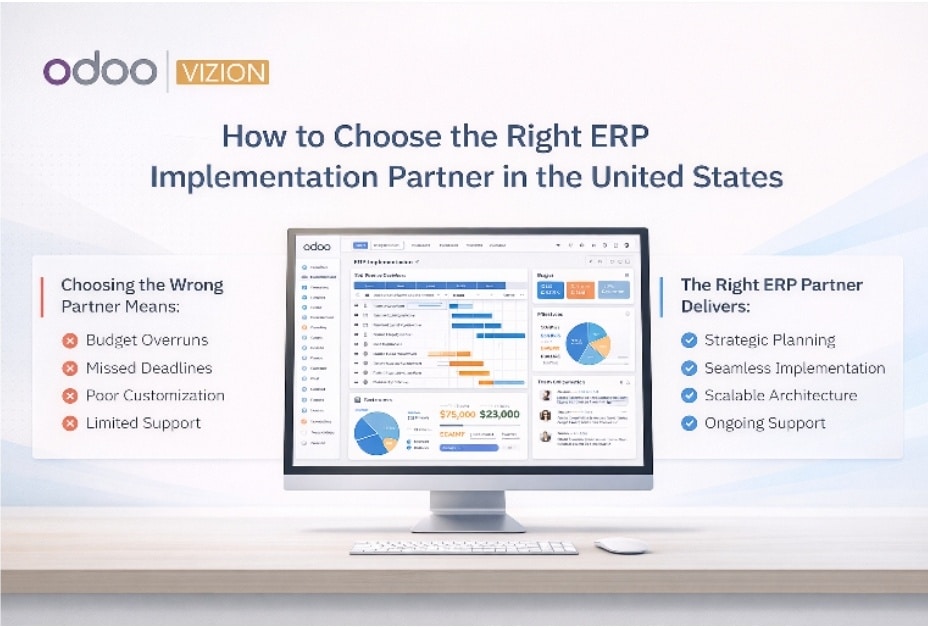
Choosing the wrong partner results in cost overruns, delayed go-live timelines, integration failures, poor user adoption, and structural inefficiencies that may persist for years. A disciplined ERP vendor selection process evaluates expertise, financial transparency, technical depth, industry understanding, and post-go-live support, not just software certification.
ERP implementation is not a software purchase decision.
It is an operational transformation decision.
Why Choosing the Right ERP Consulting Company Matters More in 2026
ERP systems today sit at the center of enterprise operations.
In 2026, organizations operate in environments defined by:
- Multi-state and multi-entity expansion
- Distributed workforce models
- Cloud-first infrastructure
- Real-time reporting expectations
- Data security compliance
- Investor scrutiny
An ERP system now integrates finance, operations, supply chain, HR, reporting, compliance, and analytics.
The implementation partner, therefore, becomes a strategic advisor, not just a service provider.
Mistakes at the partner selection stage introduce long-term structural friction.
And friction compounds.
Step 1: Establish Internal Readiness Before ERP Vendor Selection
Before evaluating any ERP implementation partner in USA, organizations must clarify internal objectives.
ERP failures frequently originate from unclear goals.
Internal Alignment Questions
- What operational inefficiencies are we trying to eliminate?
- Are we prioritizing cost savings, scalability, compliance, or reporting transparency?
- What KPIs will define project success?
- Is executive leadership aligned?
- Are we prepared for process change?
Without clarity, ERP vendor selection becomes a software feature comparison rather than a transformation decision.
A partner cannot compensate for strategic ambiguity.
Step 2: Evaluate Industry-Specific Experience
Industry alignment reduces implementation risk significantly.
A manufacturing firm requires production planning alignment.
A distribution business prioritizes inventory optimization.
A service organization focuses on project costing and resource allocation.
An experienced ERP software company understands industry workflows and regulatory nuances.
Why Industry Experience Matters
- Reduces customization risk
- Improves process mapping accuracy
- Anticipates compliance requirements
- Shortens discovery phase
- Minimizes post-go-live corrections
Request:
- Case studies
- Client references
- Comparable implementation complexity
- Multi-location project experience
Depth of experience matters more than marketing reach.
Step 3: Assess Implementation Methodology
Structured methodology is a leading predictor of ERP success.
A credible ERP implementation partner in USA should outline a defined framework, typically including:
- Discovery & Gap Analysis
- Solution Architecture Design
- Data Migration Planning
- Configuration & Controlled Customization
- User Acceptance Testing
- Training & Change Management
- Go-Live & Stabilization Phase
Without structured stages, projects drift.
Scope creep becomes common.
Budgets inflate.
Timelines extend.
Implementation discipline protects ROI.
Step 4: Technical Depth and Integration Capability
Modern ERP ecosystems require seamless integration.
Your partner must demonstrate expertise in:
- API architecture
- Third-party integrations
- Data migration strategy
- Performance optimization
- Cloud deployment
- Multi-company configuration
ERP scalability is not achieved by configuration alone; it requires architectural foresight.
An ERP implementation partner in USA must design an infrastructure that supports:
- Growth
- Acquisitions
- Multi-entity consolidation
- Regulatory expansion
Short-term configuration thinking creates long-term limitations.
Step 5: Evaluate Scalability Strategy
Many organizations underestimate scalability planning.
Ask prospective partners:
- How will this system perform if revenue doubles?
- How does the architecture support multi-currency?
- What is the strategy for future module expansion?
- How will integrations scale under higher transaction volumes?
A strong ERP consulting company builds systems for the next stage of growth, not just the present.
Step 6: Compare Cost Structure Transparently
ERP pricing can be misleading without context.
| Cost Category | Key Evaluation Criteria |
| Licensing | Subscription clarity |
| Implementation Fees | Fixed vs hourly |
| Customization | Defined scope |
| Data Migration | Included or extra |
| Support | Post-go-live model |
| Upgrades | Long-term cost |
Total Cost of Ownership (3–5 years) is more important than initial quote.
Hidden costs often include:
- Customization overrun
- Data migration complexity
- Integration maintenance
- Upgrade fees
Financial transparency is a trust indicator.
Step 7: Assess Change Management Expertise
ERP projects fail more often due to adoption issues than technical errors.
Evaluate-
- Training methodology
- Leadership communication strategy
- Resistance mitigation approach
- Adoption tracking metrics
An ERP implementation partner in USA must treat change management as a core discipline, not an afterthought.
Step 8: Long-Term Support and Advisory Capability
ERP is long-term infrastructure.
Your partner should provide:
- Hypercare stabilization
- Ongoing optimization
- Compliance updates
- Performance monitoring
- Strategic advisory for expansion
Firms like Odoo Vizion emphasize long-term advisory relationships rather than transactional deployments, a distinction that becomes important as organizations scale.
Implementation without long-term support creates fragility.
Step 9: Independent Consultant vs ERP Software Company
Organizations often debate between hiring an independent Odoo ERP Consultant or working directly with a large ERP consulting company.
| Factor | Independent Consultant | ERP Software Company |
| Personalization | High | Standardized |
| Flexibility | Strong | Moderate |
| Resource Depth | Limited | Broad |
| Industry Focus | Often niche | Often broad |
| Long-Term Advisory | Varies | Structured packages |
The right choice depends on project scale and complexity.
Step 10: Financial Risk of Poor ERP Vendor Selection
Choosing the wrong ERP implementation partner in USA can lead to:
- 20–40% cost overruns
- Delayed ROI realization
- Poor data integrity
- Integration instability
- Reduced productivity
Example:
A $3M ERP project with a 25% overrun results in $750,000 additional cost, excluding operational disruption.
Partner selection directly influences capital efficiency.
Step 11: Due Diligence Framework
Before signing:
- Request detailed project roadmap.
- Verify assigned implementation team.
- Conduct reference calls.
- Review risk management strategy.
- Clarify escalation procedures.
- Confirm data migration responsibility.
- Understand post-go-live support terms.
Structured due diligence reduces transformation risk significantly.
Step 12: Common Mistakes in ERP Vendor Selection
- Choosing based solely on price
- Ignoring scalability planning
- Underestimating data migration complexity
- Over-customizing early
- Skipping reference checks
- Failing to assess long-term support
ERP decisions shape infrastructure for years.
Governance Structure: Who Owns the ERP Decision?
One of the most overlooked aspects of selecting an ERP implementation partner in USA is governance structure.
ERP projects fail when ownership is unclear.
Too often, ERP vendor selection is delegated solely to IT. While IT plays a critical role, ERP affects finance, operations, procurement, compliance, and executive reporting.
A mature governance model should include:
- Executive sponsor (CFO / COO / CEO)
- Operational lead
- IT architecture representative
- Change management lead
- Finance oversight
Your ERP consulting company should ask early:
- Who owns final decision-making authority?
- Who resolves cross-department conflicts?
- Who defines scope boundaries?
- Who approves change requests?
If a partner does not emphasize governance alignment early, that is a warning sign.
Strong implementation partners insist on structured governance because they understand that technology decisions without leadership structure create instability.
Data Migration: The Hidden Risk Factor
Data migration is one of the highest-risk areas in ERP implementation.
It is also one of the most underestimated.
When evaluating an ERP implementation partner in USA, ask detailed questions about:
- Data cleansing processes
- Historical data migration scope
- Data validation procedures
- Parallel testing methods
- Master data governance
Poor migration planning can result in:
- Financial reporting discrepancies
- Inventory inaccuracies
- Customer record duplication
- Compliance gaps
The right ERP consulting company will not treat migration as a technical afterthought.
They will:
- Conduct data audits.
- Identify redundant or corrupted records.
- Define what historical data truly needs migration.
- Test migration in controlled environments.
- Validate outputs before go-live.
Migration quality directly affects trust in the new system.
Trust determines adoption.
Customization vs Configuration: A Critical Decision
Many ERP projects fail because of excessive customization.
Customization increases:
- Implementation cost
- Upgrade complexity
- Technical debt
- Vendor dependency
A disciplined ERP implementation partner in USA will challenge unnecessary customization requests.
They will help you evaluate:
- Is this process truly unique?
- Can we adapt workflow instead of customizing code?
- What is the long-term maintenance cost?
- How will this affect upgrades?
Configuration-first strategy protects scalability.
Customization should be reserved for:
- Regulatory requirements.
- True competitive differentiation.
- Mission-critical process uniqueness.
Partners who readily agree to heavy customization may be optimizing short-term revenue, not long-term client success.
Cybersecurity and Compliance Readiness
In 2026, cybersecurity risk is inseparable from ERP architecture.
ERP systems store:
- Financial data
- Payroll data
- Vendor contracts
- Customer information
- Compliance documentation
When selecting an ERP implementation partner in USA, evaluate:
- Role-based access control design
- Data encryption standards
- Audit trail capability
- Compliance mapping
- Backup and disaster recovery planning.
Ask specific questions:
- How do you structure user permissions?
- What compliance frameworks have you supported?
- How do you handle security updates?
- What is your disaster recovery recommendation?
An ERP consulting company must treat security as infrastructure design, not a configuration checkbox.
Security weakness undermines trust and increases regulatory exposure.
Measuring ROI: Beyond Go-Live Success
Many organizations define ERP success as “system live on time.”
That is insufficient.
The right ERP implementation partner in USA helps define measurable ROI metrics.
Examples include:
- Reduction in reporting cycle time.
- Decrease in inventory carrying cost.
- Improvement in procurement accuracy.
- Reduction in manual reconciliation effort.
- Increase in system adoption rate.
Define baseline metrics before implementation.
Then measure improvement at:
- 3 months
- 6 months
- 12 months
An experienced ERP consulting company will structure post-go-live reviews to evaluate performance impact, not just technical stability.
Transformation without measurement lacks accountability.
Cultural Fit and Long-Term Relationship Dynamics
ERP implementation is not a short engagement.
It is often a 5–10-year relationship.
Cultural alignment matters.
Evaluate:
- Communication style
- Escalation transparency
- Responsiveness
- Documentation clarity
- Willingness to challenge assumptions
Some organizations prioritize purely technical expertise.
However, the strongest ERP implementation partner in USA will also demonstrate:
- Executive-level communication
- Risk transparency
- Realistic timeline forecasting
- Strategic thinking beyond configuration
Firms like Odoo Vizion often emphasize long-term advisory alignment rather than transactional implementation, a distinction that becomes significant as businesses scale.
The partner you choose today may influence infrastructure decisions for years.
Choose accordingly.
Conclusion
Choosing the right ERP implementation partner in USA determines whether your ERP becomes a strategic asset or an operational liability.
ERP implementation is not about installing software.
It is about building resilient infrastructure that supports growth, compliance, integration, and long-term scalability.
A disciplined ERP vendor selection process reduces risk, protects capital, and ensures transformation success.
The right partner does not just deploy technology.
They align infrastructure with ambition.
FAQs
How long does ERP implementation take in the United States?
ERP implementation timelines vary based on company size, operational complexity, and customization requirements. For mid-sized organizations, implementation typically ranges between 4 to 9 months. More complex projects involving multi-entity structures, advanced integrations, or industry-specific customization may extend beyond 12 months.
What is the most important factor when choosing an ERP consulting company?
The most critical factor is not certification alone, but a combination of structured implementation methodology and industry alignment. A partner who understands your sector’s workflows, regulatory landscape, and scalability requirements will reduce customization risk and implementation friction.
Is certification enough when selecting an Odoo partner USA?
Certification confirms product familiarity and technical training, but it does not guarantee implementation success. When evaluating an Odoo partner USA, businesses should also assess execution discipline, integration expertise, scalability planning capability, and change management experience.
How important is post-go-live support?
Post-go-live support is critical. The first 60–90 days after deployment often determine user adoption, performance stability, and system optimization. Continuous monitoring, issue resolution, workflow refinement, and scalability adjustments typically occur during this phase. Without structured post-launch support, organizations risk underutilizing their ERP investment.
Should we choose an ERP implementation partner based on lowest cost?
Selecting based solely on the lowest price increases long-term risk. Lower upfront costs may conceal limited scope, reduced support coverage, or excessive customization charges later.