

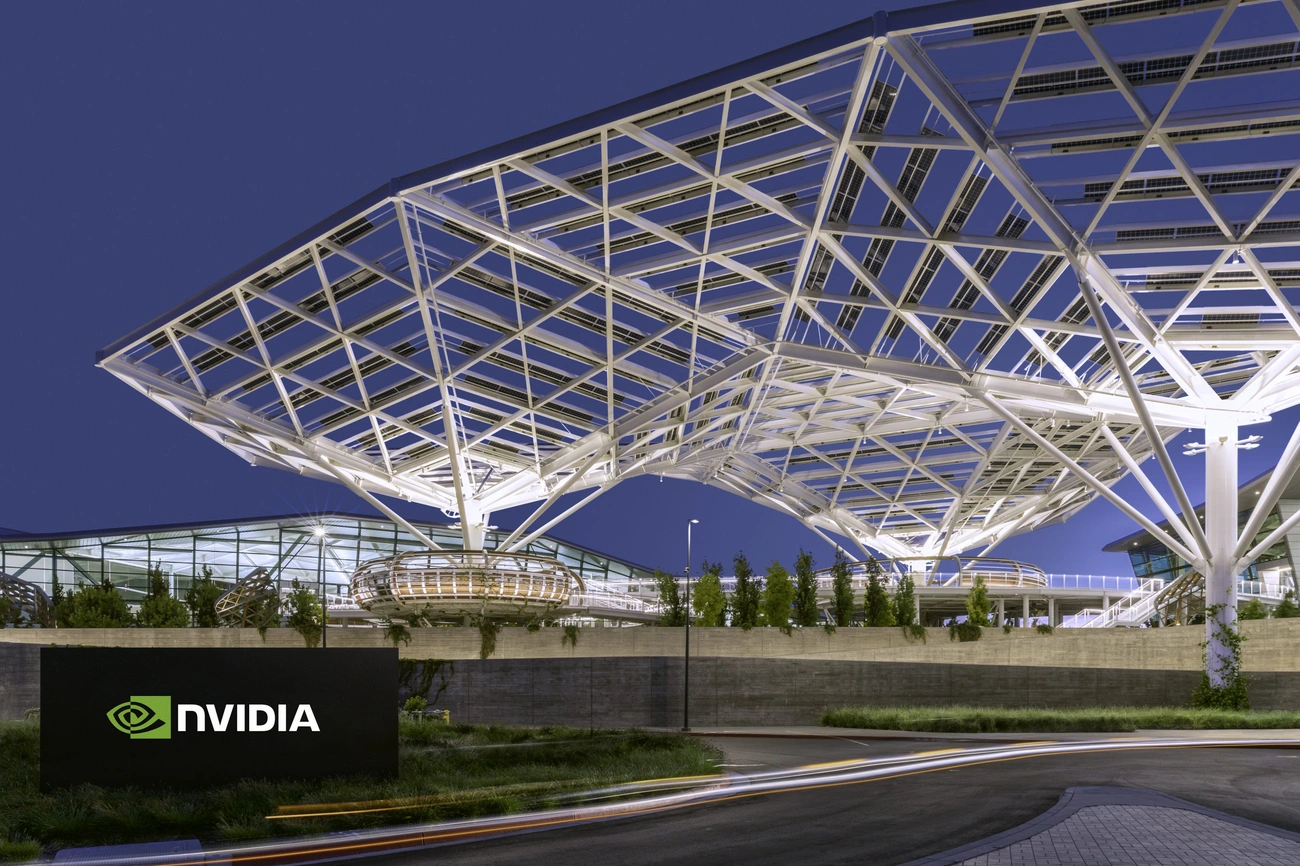

Nvidia made history as the first company to hit a $5 trillion market value. This unprecedented milestone shows how AI has changed the tech world. The company’s growth tells an amazing story – from $1 trillion just two years ago to $4 trillion three months back.
Nvidia’s value now surpasses every country’s GDP except the United States and China. The company’s market worth towers above all its rivals combined – AMD, Intel, Broadcom, and TSMC. Since ChatGPT launched in 2022, Nvidia’s shares have soared 12-fold, and this surge pushed the company to the top of stock market rankings. The former video game graphics company has become the engine that powers today’s AI revolution. Nvidia’s latest milestone celebrates this remarkable transformation as the company continues to grow.
Nvidia becomes first company to reach $5 trillion market cap

Image Source: The Business Standard
Nvidia made history on October 29, 2025, becoming the first company to close with a market cap above $5 trillion. The company reached this milestone just three months after crossing the $4 trillion mark, showcasing its incredible rise to become the world’s most valuable company.
The stock jumped 3% that Wednesday, closing at $207.04 and pushing Nvidia’s total market value to $5.03 trillion. A series of key announcements and positive market signals boosted investor confidence in the AI chip giant’s market leadership.
President Trump’s comments played a vital role in this achievement. He mentioned discussing “Blackwells” with CEO Jensen Huang before their planned meeting, hinting at possible approval for exporting Nvidia’s advanced AI chips to China. This news sparked hope about Nvidia’s future in the Chinese market, especially after the company reported zero sales of its H20 chips there earlier in the year.
The stock had already surged 5% the previous day after several major announcements at Nvidia’s GTC event in Washington, D.C. These included:
- A deal with the US Department of Energy to build seven supercomputers, one featuring 10,000 Blackwell GPUs
- A project with Uber to create self-driving vehicles
- Supply of 1,000 GPUs to Eli Lilly
- Development of 6G cellular technology with Nokia
- AI partnerships with Palantir, Oracle, Cisco, and T-Mobile
- Robot development with Amazon, Foxconn, Caterpillar, and Belden
CEO Jensen Huang made a bold prediction during his keynote speech: Nvidia expects $500 billion in GPU sales through 2026. This target seems ambitious considering the company’s revenue just topped $100 billion in the first two quarters of 2025.
Nvidia has become a powerhouse in the market. Its $5 trillion valuation now exceeds the entire cryptocurrency market and puts it ahead of other tech giants in the trillion-dollar club. The company’s market cap had reached $4.23 trillion earlier in 2024, with $165.20 billion in revenue and $86.60 billion in net income over twelve months.
The stock’s performance has been remarkable. Shares gained over 50% in 2025 and doubled from their April lows after Trump’s “Liberation Day” tariff announcements briefly shook the markets.
Matt Britzman, senior equity analyst at Hargreaves Lansdown, said it best: “Nvidia hitting a $5 trillion market cap is more than a milestone; it’s a statement, as Nvidia has gone from chip maker to industry creator. The market continues to underestimate the scale of the opportunity, and Nvidia remains one of the best ways to play the AI theme”.
This milestone means more than just financial success. It shows how Nvidia evolved from a graphics-chip designer into the foundation of global AI. The achievement has turned CEO Jensen Huang into a Silicon Valley icon and made the company’s chips central to the tech rivalry between the United States and China.
AI boom fuels Nvidia’s meteoric rise
Nvidia’s path changed forever in November 2022. The company evolved from a respected GPU manufacturer into the life-blood of global AI infrastructure.
ChatGPT and the start of the AI arms race
OpenAI’s public release of ChatGPT sparked a global AI race that nobody saw coming. Tech giants rushed to develop their own generative AI systems. They needed specialized hardware to train and run these sophisticated models.
Companies built larger language models with exponentially growing hardware needs. Advanced AI systems like GPT-4 need thousands of GPUs working together for months. This created a perfect market for Nvidia to benefit from its AI-optimized hardware investments.
Nvidia’s financial results soared right after ChatGPT’s debut. The company’s data center revenue grew 80% year-over-year in the first quarter. By mid-2023, this growth reached 171%, marking the start of what analysts call the “Nvidia supercycle.”
How Nvidia’s GPUs became essential to AI
Nvidia’s AI sector leadership took years to build. The company started its journey to become vital to AI development over a decade ago. They recognized their graphics processors worked perfectly for AI’s parallel processing needs.
The company’s CUDA programming model, launched in 2007, proved vital. This platform lets developers use Nvidia GPUs for computing tasks beyond graphics. CUDA became the standard for AI development as more CUDA-based AI tools emerged.
Nvidia’s tensor cores – specialized units for deep learning operations – outperformed all competitors. The H100 GPU launched in 2023 ran AI tasks 30 times faster than older versions. This technical edge came just as the market exploded.
Market dominance followed this technical superiority. Analysts say Nvidia now controls 95% of the GPU market for AI training. This gives them unmatched pricing power and influence in the industry.
Nvidia’s $500B chip order announcement
Jensen Huang’s projection of $500 billion in GPU sales through 2026 stood out at Nvidia’s GTC event. This number – five times Nvidia’s 2024 revenue – amazed investors.
Real orders backed these numbers. Microsoft, Google, Amazon, and Meta committed billions to secure Nvidia’s next-generation chips. Reports indicate Microsoft plans to spend $50 billion on Nvidia hardware over three years.
These orders show how much these companies value AI infrastructure. They see Nvidia chips as essential tools to compete in AI-powered markets.
Nvidia worked with TSMC to secure production capacity despite industry supply issues. High-end AI chips still take over six months to deliver. This seller’s market keeps pushing revenue growth and Nvidia’s stock price higher.
A positive cycle drives Nvidia’s business. Limited supply of advanced chips creates demand. This allows premium pricing, which funds research into better products. The cycle extends Nvidia’s technical lead and explains its extraordinary market value growth.
Jensen Huang leads Nvidia’s transformation into AI powerhouse
Jensen Huang, founder and CEO of Nvidia, has led the company’s remarkable rise to a $5 trillion market cap over the past 31 years. His story stands as one of technology’s greatest leadership tales. The company transformed from a specialized graphics chip maker into the world’s most valuable company under his steadfast dedication to become the undisputed leader in AI infrastructure.
From gaming chips to AI infrastructure
Huang made a crucial choice in 2006 that steered Nvidia away from gaming toward artificial intelligence. He saw that GPUs could do more than render graphics. Rather than treating AI as another market opportunity, he made it Nvidia’s future cornerstone. The CUDA platform marked this strategic insight, letting developers employ GPU computing power for scientific and AI applications.
“We bet the company on AI,” Huang often says in interviews, pointing to Nvidia’s early investment in the technology while competitors looked elsewhere. This calculated risk required major resources to develop specialized tensor cores and AI-optimized architectures. The company managed to keep its strong position in gaming simultaneously.
Nvidia’s true transformation began with its first dedicated AI chip in 2016. Huang then made an even more crucial decision to build complete AI ecosystems beyond just hardware. This move secured Nvidia’s unbeatable market position. The company’s software platforms – CUDA, cuDNN, and various industry-specific SDKs – now create strong lock-in effects that competitors find hard to match.
CEO’s net worth and public image
Huang’s personal wealth has grown with Nvidia’s success. His 3.5% ownership translates to over $175 billion, ranking him among the world’s richest people. He maintains a modest public presence compared to other tech billionaires.
His black leather jacket appears at every public event and has become a Silicon Valley icon. This thoughtful branding choice shows consistency and focus rather than excess. His deep technical discussions rather than flashy presentations have earned respect from Nvidia’s core audience of developers and engineers.
Huang differs from typical tech CEOs. He stays away from political debates and social media disputes. His communications remain focused on technology and Nvidia’s mission. This disciplined approach has protected him and Nvidia from controversies that plague other tech leaders.
Leadership style and long-term vision
A unique blend of demanding technical standards and consistent vision defines Huang’s leadership. His former employees describe him as detail-focused, often examining specific technical details most CEOs would pass on. He personally reviews product designs and sometimes asks teams to improve features that don’t meet his standards.
“Jensen thinks in decades, not quarters,” a former Nvidia executive notes. This long-term mindset shows in Nvidia’s research priorities, which often look 5-10 years ahead of current market needs. The architecture for Nvidia’s Blackwell chips started development years before the current AI boom created massive demand.
Huang has fostered a culture of technical excellence at Nvidia. The company consistently outperforms competitors in both innovation and execution. While other semiconductor companies face occasional technical challenges, Nvidia delivers promised performance improvements reliably.
His combination of forward thinking, technical precision, and reliable execution has helped Nvidia evolve from a specialized component maker into the foundation of AI infrastructure. The company now ranks among history’s most valuable enterprises.
Geopolitical tensions shape Nvidia’s global strategy
The US-China geopolitical tensions are now a key factor in Nvidia’s global strategy. The company’s value has exceeded $5 trillion, and these international dynamics now affect both corporate decisions and the company’s stock price swings.
Blackwell chip and U.S.-China export controls
The Blackwell chip stands right in the middle of US-China technology disputes. National security concerns have led to strict export controls on these next-generation processors that power the world’s most advanced AI systems. These restrictions have limited Nvidia’s sales of its most powerful chips to Chinese customers, and the company lost what used to be a major source of revenue.
The company ended up developing specialized, lower-performance variants just for the Chinese market because of these export controls. The modified chips, including the H20 model launched this year, ran into unexpected problems. The company reported almost no H20 chip sales in China during the launch period, which shows how complicated these restrictions are.
The Commerce Department won’t allow advanced chips and chip-making equipment to be exported to China without special licenses. The rules target processors that exceed certain performance levels that could help Chinese military capabilities or surveillance systems.
Trump-Xi talks and Nvidia’s role in diplomacy
Nvidia’s chips have become central to diplomatic talks between world leaders. Trump said he plans to meet with CEO Jensen Huang to talk about possibly relaxing some Blackwell chip export restrictions to China. This news alone pushed Nvidia’s market cap up by 3%, which shows how deeply the company is tied to international relations.
Trump specifically mentioned “speaking about Blackwells” before his planned meeting with Chinese President Xi Jinping. This kind of direct reference to a company’s products in high-level diplomatic talks rarely happens and shows Nvidia’s strategic importance.
These diplomatic moves might signal a change in how the US handles technology transfers to China. Market analysts believe any easing of export controls could transform Nvidia’s revenue outlook, given China’s huge appetite for AI infrastructure.
Nvidia’s balancing act between markets
Nvidia faces unprecedented challenges as it tries to keep access to global markets while following complex geopolitical rules. The company must balance:
- Getting the most revenue from unrestricted markets (U.S., Europe, and allies)
- Creating China-specific products that follow export rules
- Keeping good relationships with Chinese partners while staying on good terms with U.S. regulators
This balancing act affects the company’s value directly. To cite an instance, just hints about easier export rules helped push the company’s stock to the $5 trillion mark. When Trump announced “Liberation Day” tariffs earlier this year, Nvidia’s shares dropped briefly before hitting new highs.
The stakes couldn’t be higher. China makes up about 25% of the global semiconductor market – it’s too big for Nvidia to ignore. The company’s growth and market leadership now depend in part on solving these export challenges.
Nvidia works hard behind the scenes with government relations experts in Washington, Beijing, and Brussels to support policies that help its business. During these complex talks, the company always emphasizes that its technology serves mainly commercial and research purposes, not military ones.
These geopolitical tensions affect more than just Nvidia’s current sales numbers. They shape the company’s long-term research priorities and product development plans as it adapts its technology to succeed in an increasingly divided global tech ecosystem.
Stock surge boosts Nvidia’s market dominance
Nvidia has become the dominant force in semiconductor and technology sectors, thanks to its outstanding stock performance throughout 2025. The company’s shares have shown remarkable strength and growth during market volatility, leaving rivals far behind.
Nvidia current stock price vs. competitors
Nvidia’s stock value towers over its direct competitors in chip manufacturing. The company trades at $207 per share while AMD sits at $185 and Intel at $55. This price gap shows Nvidia’s unmatched position in AI processing technology.
The difference between Nvidia and competitors goes beyond share prices. Nvidia’s trailing price-to-earnings ratio is about twice AMD’s and four times Intel’s. Analysts believe this premium makes sense given Nvidia’s stronger growth path and its leadership in the AI chip market.
Nvidia stock market cap vs. Apple and Microsoft
Nvidia has joined an elite club by reaching the $5 trillion valuation mark, surpassing both Apple at $4.7 trillion and Microsoft at $4.8 trillion. This new pecking order signals a big change in how global technology companies are ranked.
Back in early 2023, Nvidia’s market value was just a quarter of Apple’s. AI has completely altered the map of investor priorities and market values. Nvidia became the first company to cross $5 trillion because markets now value AI infrastructure more than consumer technology or enterprise software.
Investor confidence and tech sector influence
Nvidia’s incredible rise in value has changed how major market indices work. The company now makes up almost 10% of the entire S&P 500’s market value. This concentration gives Nvidia significant power over broad market performance, and many index funds now act like mirrors of Nvidia’s performance.
Investors trust Nvidia as much as they do century-old consumer brands. Small investors have rushed to buy the stock, making it one of the most popular choices on Robinhood. Big institutional investors have also jumped in, with some growth funds putting more than 15% of their money into Nvidia.
Today’s enthusiastic response to Nvidia news shows investors believe in both its current products and its plans for future AI chips and software systems.
Analysts warn of AI bubble and market concentration

Image Source: Reddit
Financial experts have started raising red flags about potential market imbalances despite the excitement over Nvidia’s historic success. The recent market gains show heavy concentration in specific areas, which brings up questions about long-term stability and risk.
Comparisons to dot-com bubble
Nvidia’s skyrocketing value has prompted many analysts to draw parallels with the dot-com era. They often compare Nvidia to Cisco Systems before the 2000 crash. Some skeptics point to charts that show remarkably similar stock patterns between these companies. The biggest difference lies in the numbers – Cisco’s forward P/E ratio hit 100-150 at the bubble’s peak, while Nvidia’s current forward P/E sits at 25.5. Nvidia shows stronger fundamentals than Cisco did, as Cisco’s margins kept shrinking before the crash due to competition.
S&P 500 dependency on tech giants
The market shows unprecedented concentration – just 41 AI-related stocks make up 47% of the S&P 500’s total market value, though they represent only 8% of the index. These stocks have driven 74% of the S&P 500’s total growth since ChatGPT’s launch. Macro researcher Jim Bianco calls this “the most significant concentration around a single theme that ever spread”.
Skepticism about AI’s ground productivity
Many investors remain optimistic about AI, yet questions linger about whether massive infrastructure spending will boost productivity enough. Kamila Elliott, CEO of Collective Wealth Partners, points out that many retirement savers don’t realize five companies largely determine their portfolio’s performance – Nvidia, Microsoft, Apple, Alphabet, and Amazon. This concentration works against diversification principles and could expose investors to major risks if AI fails to deliver.
Market concentration has reached levels not seen since the Great Depression, with the top 10% of U.S. stocks representing more than three-quarters of total market value. This creates a risky situation where any slowdown in AI adoption could trigger wider market corrections and affect millions of investors who might not understand their exposure.
Conclusion
Nvidia reached a $5 trillion market capitalization – a defining moment that impacts both the company and the entire technology sector. The company hit this historic milestone just three months after crossing the $4 trillion mark, showing the incredible momentum driven by the global AI revolution. Jensen Huang’s visionary leadership helped Nvidia transform from a gaming graphics company into the backbone of global AI infrastructure in record time.
The company’s meteoric rise stems from multiple factors. Nvidia placed itself at the heart of the AI boom that ChatGPT’s 2022 launch triggered. The company’s technological edge through its CUDA platform and specialized tensor cores created powerful network effects that competitors find nowhere near easy to match. Huang’s vision to build complete AI ecosystems rather than just hardware created an unbeatable market position.
The United States and China’s geopolitical tensions shaped Nvidia’s global strategy, as export controls on advanced chips became central to diplomatic talks. Trump’s recent hints about easing restrictions on Blackwell chip exports directly pushed Nvidia’s stock past the $5 trillion mark.
The company now towers above tech giants like Apple and Microsoft in market value, but critics raise valid concerns about market concentration. AI-related stocks, just 41 in number, generate nearly three-quarters of the S&P 500’s total increase since ChatGPT’s release – a level of thematic concentration never seen before in market history.
Market watchers draw parallels between Nvidia and pre-crash Cisco Systems from the dot-com era. Notwithstanding that, key differences exist – Nvidia shows stronger financial fundamentals with a forward P/E ratio of 25.5 compared to Cisco’s 100-150 during the bubble peak.
Nvidia’s $5 trillion valuation means more than financial success; it represents a transformation in what markets value most. The company embodies AI’s revolutionary potential while highlighting both the extraordinary opportunities and risks in today’s concentrated market world. The sustainability of this valuation depends on AI delivering the efficiency gains that investors expect from Nvidia’s next-generation technologies.
FAQs
Q1. What milestone did Nvidia recently achieve in terms of market capitalization? Nvidia recently became the first company in history to reach a $5 trillion market capitalization, surpassing tech giants like Apple and Microsoft.
Q2. What factors contributed to Nvidia’s rapid growth in recent years? Nvidia’s growth was primarily fueled by the AI boom, its dominance in AI chip manufacturing, strategic positioning in the AI infrastructure market, and the increasing demand for its GPUs in various industries.
Q3. How has Nvidia’s CEO, Jensen Huang, influenced the company’s success? Jensen Huang’s visionary leadership transformed Nvidia from a gaming graphics company into an AI powerhouse. His long-term focus, technical expertise, and strategic decisions to invest heavily in AI technology have been crucial to Nvidia’s success.
Q4. How are geopolitical tensions affecting Nvidia’s business strategy? Geopolitical tensions, particularly between the US and China, have significantly impacted Nvidia’s global strategy. Export controls on advanced chips have forced the company to navigate complex regulations and develop market-specific products while maintaining diplomatic relationships.
Q5. Are there concerns about Nvidia’s rapid growth and market dominance? Yes, some analysts have raised concerns about potential market imbalances, drawing comparisons to the dot-com bubble. There are also worries about the concentration of market value in a small number of AI-related stocks, including Nvidia, which could pose risks to investor portfolios and market stability.