

Introduction
Modern long-haul flights regularly cross vast oceans and remote regions where airports are hundreds or even thousands of miles apart. For passengers, these flights may seem routine, but behind the scenes strict aviation rules ensure that aircraft can safely operate far from diversion airports.
One of the most important of these rules is ETOPS, a regulatory framework that determines how far twin-engine aircraft can fly from the nearest suitable airport. ETOPS has played a crucial role in shaping modern international aviation, allowing airlines to operate efficient long-distance flights while maintaining extremely high safety standards.
Understanding what ETOPS is in aviation helps explain how modern aircraft can safely travel between continents such as North America, Europe, Asia, and Australia. It also explains why airlines can operate long over-water routes with aircraft that have only two engines.
What Does ETOPS Mean in Aviation?
ETOPS stands for Extended-range Twin-engine Operational Performance Standards.
These regulations define how far a twin-engine aircraft can fly from the nearest diversion airport during long-distance flights. The rules ensure that even if one engine fails or another serious issue occurs, the aircraft can still safely reach an alternate airport.
In simple terms, ETOPS determines three critical safety factors:
- How far an aircraft may fly from the nearest diversion airport
- How long it would take to reach that airport if an engine fails
- Whether the aircraft and airline meet reliability standards for long-distance routes
These regulations are enforced by aviation authorities such as:
- Federal Aviation Administration (FAA) in the United States
- European Union Aviation Safety Agency (EASA) in Europe
- Other national aviation regulators worldwide
ETOPS certification ensures that aircraft operating long-haul flights are capable of maintaining safety even in remote regions of the world.
Why ETOPS Was Introduced
In the early decades of commercial aviation, most long-distance flights were operated by aircraft with three or four engines.
Aircraft such as the Boeing 747, Douglas DC-10, and Lockheed L-1011 were commonly used for long ocean crossings because aviation authorities believed that multiple engines provided extra safety redundancy.
Twin-engine aircraft were restricted from flying far away from airports because regulators were concerned that losing one engine could create dangerous situations over remote areas such as oceans or polar regions.
However, technological advancements dramatically improved aircraft reliability.
Modern jet engines became extremely dependable, and aircraft systems improved significantly. As a result, aviation authorities introduced ETOPS regulations to allow twin-engine aircraft to safely perform long-distance flights.
Today, aircraft such as the Airbus A350, Boeing 787, and Boeing 777 routinely cross oceans under ETOPS certification.
ETOPS Certification Levels
Aircraft operating under ETOPS are assigned specific certification levels that determine how far they can fly from a diversion airport.
These certifications are based on the aircraft’s reliability and operational performance.
Common ETOPS ratings include:
ETOPS-120
Aircraft certified under ETOPS-120 can fly up to 120 minutes away from the nearest diversion airport at single-engine cruise speed.
This certification is typically sufficient for many routes over land or coastal regions.
ETOPS-180
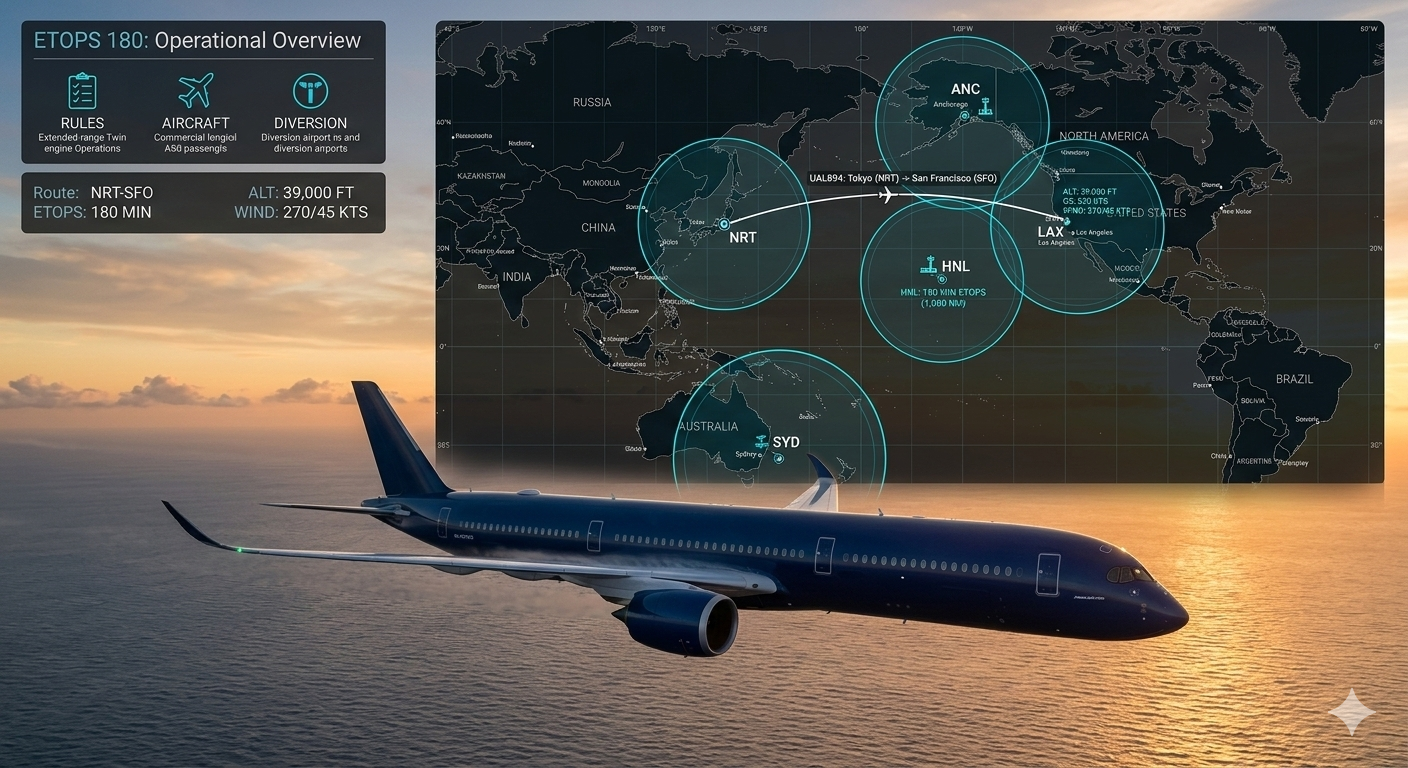
ETOPS-180 allows aircraft to fly up to 180 minutes (three hours) from the nearest diversion airport.
This level of certification enables many transatlantic routes and long ocean crossings.
Many modern long-haul aircraft operate under this certification level.
ETOPS-240 and Higher
Some modern aircraft receive ETOPS-240 or ETOPS-330 certification, allowing them to fly up to four or even five hours from the nearest diversion airport.
These certifications enable airlines to operate extremely long routes across remote ocean regions, including polar routes between North America and Asia.
Higher ETOPS ratings allow airlines to plan more direct routes, which reduces flight time and fuel consumption.
How ETOPS Protects Passenger Safety
Although engine failures are extremely rare in modern aviation, ETOPS regulations ensure that aircraft always remain within reach of an alternate airport.
If a serious issue occurs during flight, the aircraft can divert and land safely.
Airlines must meet strict operational requirements before flying ETOPS routes.
These requirements include:
- Additional aircraft maintenance inspections
- Specialized training for pilots and flight crews
- Advanced flight planning procedures
- Continuous engine reliability monitoring
- Backup systems for critical aircraft components
Airlines must also demonstrate strong reliability records before receiving ETOPS certification for their aircraft fleets.
These strict safety measures help maintain one of the safest transportation systems in the world.
How ETOPS Changed Modern Aviation
ETOPS has transformed the way airlines operate international flights.
Without ETOPS regulations, airlines would still need to rely on aircraft with three or four engines for long-distance routes.
Those aircraft are typically heavier, consume more fuel, and are more expensive to operate.
By allowing efficient twin-engine aircraft to operate long routes safely, ETOPS has enabled airlines to:
- Reduce fuel consumption
- Lower operating costs
- Offer more direct flight routes
- Improve environmental efficiency
- Expand global air travel networks
As a result, ETOPS has played a major role in shaping modern aviation.
Examples of Aircraft Operating Under ETOPS
Many of today’s most advanced aircraft operate under ETOPS certification.
Examples include:
- Airbus A350
- Boeing 787 Dreamliner
- Boeing 777
- Airbus A330
These aircraft routinely perform long-haul flights between continents and across large oceans.
Passengers traveling between cities such as New York, Tokyo, London, Sydney, or Dubai are often flying on aircraft operating under ETOPS regulations.
Why ETOPS Matters for Long-Haul Flights
ETOPS is essential for enabling modern long-haul travel.
It ensures that aircraft flying across oceans or remote areas can always reach a safe landing airport if an unexpected situation occurs.
Without ETOPS, many international routes would be longer, more expensive, and less efficient.
Today, ETOPS allows airlines to operate some of the world’s longest flights safely while maintaining strict safety oversight.
For passengers, these regulations operate quietly in the background, ensuring that every long-distance flight meets some of the highest safety standards in transportation.